How is distilled water different from filtered water?
The goal of both 'filtering' and 'distilling water' is to produce water with fewer impurities. The main difference between distilled water and filtered water is that there is an active process involved in producing distilled water, whereas with filtered water, as it name suggests, water simply goes through a non mechanical filtering process only.
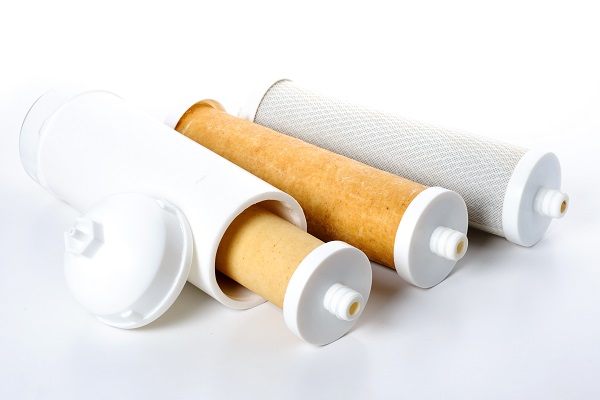
Filtered water is any water that has passed through a filter medium. That medium could be a jug filter at home, a carbon block cartridge, a sediment filter, a membrane, or a combination system. The filter type determines what is reduced. Many household systems focus on improving taste and odour, reducing chlorine, and trapping particles. Some advanced systems can reduce additional substances, but the performance depends on filter design, condition, and how often it is replaced.
Distilled water is produced through distillation. Water is heated until it becomes steam, and the steam is then cooled and condensed back into liquid water. This change of state is important because many substances that are dissolved in water, such as minerals and salts, do not evaporate with the water. In a typical distillation setup, those substances are left behind in the boiling chamber, and the condensed water is collected separately.
How filtered water is made
Filtration can mean several different technologies, and it is worth understanding them in practical terms.
A simple sediment filter is designed to remove particles, such as rust, sand, and other suspended solids. It improves clarity but does not remove dissolved minerals, as those are not particles.
Activated carbon is extremely common in domestic filters. It can reduce chlorine and some organic compounds that affect taste and odour. It can also reduce certain trace contaminants, depending on the filter specification. It does not remove minerals in the way distillation does. That means filtered water can still contain calcium and magnesium, which are the main contributors to limescale.
Ion exchange (deionisation) is used in some systems to reduce hardness. It swaps calcium and magnesium ions for other ions. This can reduce scale formation, but it still does not produce the same type of low-mineral water you get from distillation, and the results depend on the resin and the system design.
Reverse osmosis is often described as filtration but is better thought of as a membrane separation process. It can reduce a wide range of dissolved substances by pushing water through a semi-permeable membrane. It can produce water with very low mineral content. However, performance depends heavily on membrane quality, water pressure, feedwater chemistry, and maintenance. It also commonly produces wastewater as part of the process.
Because filtered water is a broad category, two people can both say they use "filtered water" and mean completely different things.
How Distilled Water is made
Distillation, by contrast, has a clear mechanical principle. Heat turns water into vapour. Condensation turns vapour back into water. Most dissolved minerals and salts do not travel with the steam, so they remain behind. This is why distillation is a traditional method for producing low-mineral water for technical uses.
In practical use, distillation is valued for consistency. When a product is described as distilled, the expectation is that it has been produced using that evaporation-and-condensation method, resulting in water with greatly reduced mineral content. This matters in appliances and processes where minerals are the main problem.
What each type removes
Filtered water is typically good at reducing certain things, depending on the filter.
Many filters reduce chlorine and improve taste. Many remove particles. Some reduce certain metals or organic contaminants. Some reduce hardness. Advanced systems can reduce a great deal, but this relies on correct installation, stable water conditions, and regular replacement of parts.
Distilled water is particularly associated with reducing dissolved minerals, salts, bacteria and heavy metals. If you are trying to avoid mineral deposits, this is often the deciding factor. Limescale is driven by minerals. Even water that tastes good can still form deposits when heated or evaporated.
Why limescale and mineral residue matter
For a lot of everyday decisions, the difference between distilled and filtered water shows up as residue.
In a steam iron, minerals can leave deposits that block steam vents. In a humidifier, minerals can appear as white dust on surfaces. In a coffee machine or kettle, minerals build scale on heating elements. In a car battery top-up, dissolved minerals are not desirable because they can affect performance and shorten component life.
Filtered water can still contain enough minerals to create these issues, especially if the filter is designed for taste rather than demineralisation. A carbon jug can make water taste cleaner and still leave limescale behind. Many people only notice later, when appliances start to show build-up.
Distilled water is often chosen when the goal is to minimise residue and avoid mineral-related problems. It is not an emotional choice. It is a technical one. When minerals are what cause the trouble, removing minerals becomes the simplest strategy.
Consistency and predictability
One of the advantages of distilled water is predictability. Filter performance changes over time. Cartridges become saturated. Flow rates change. Replacement schedules are not always followed precisely. A filter that was working well last month may now be doing less, without any obvious sign.
Distilled water is purchased as a finished water from us with a defined production method and guaranteed purity. When you need repeatable results, such as topping up a lead-acid battery, preparing solutions, or using sensitive equipment, repeatability can be as important as cleanliness. This is why distilled water is commonly associated with technical tasks rather than general drinking.
Common uses where distilled water is essential
Distilled water tends to be selected when mineral content causes build-up, poor performance, or maintenance issues.
CPAP machines are a common example. Heated humidification can leave mineral deposits over time if minerals are present. Many users prefer to reduce that risk by choosing distilled water, because it helps keep the chamber cleaner and can reduce the frequency of descaling.
Humidifiers used in rooms can create mineral dust if the water contains dissolved minerals. Using distilled water helps reduce that dust and keeps the appliance cleaner.
Steam irons, steam cleaners, and similar appliances benefit in the same way, because they heat water and concentrate whatever is dissolved in it.
Batteries and technical equipment are another category. When a manual specifies distilled water, it is usually about avoiding mineral-related chemical effects and residues.
If you are choosing water to avoid limescale, mineral deposits, white dust, blocked vents, stained surfaces, or build-up inside equipment, distilled water is often the more straightforward answer. It removes the part of the water that causes the problem. It also reduces the need to think about how well a particular filter is performing this month.
Filtered water can be excellent. Distilled water can be excellent. They are simply designed for different outcomes. When the job is sensitive to minerals, distilled water aligns naturally with the requirement, and it does so without relying on filter life, cartridge changes, or variable performance.
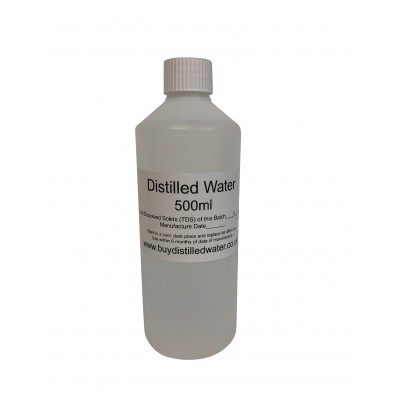
IN STOCK NOW! Our 500ml bottle of Distilled Water - Perfect for use at home in steam irons, humidifiers, steam generators etc.
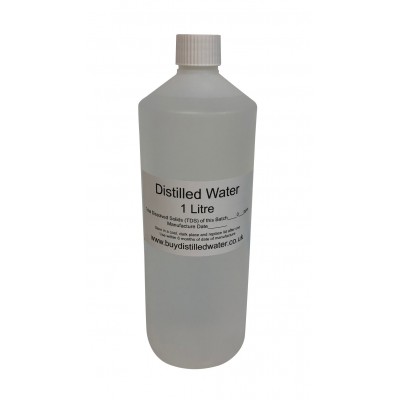
From £2.90 ex. VAT.
IN STOCK NOW! This handy 1 Litre bottle size is perfect for regular home users as well as 'one-off' research and testing purposes.
From £4.45 ex. VAT.
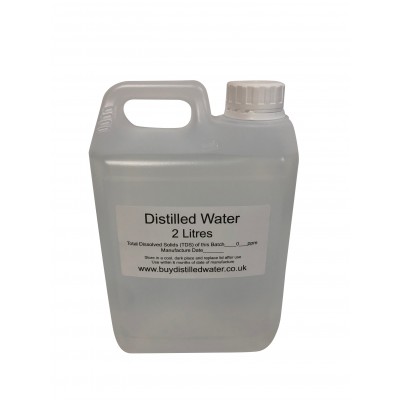
IN STOCK NOW! Our 2 litre Distilled Water bottle is more economical than our 1 litre bottles, but still very easy to carry and pour. It comes complete with a tamper-evident screw cap
IN STOCK NOW! Our 250ml bottle of Distilled Water - Perfect for use at home in steam irons, humidifiers, steam generators etc.
Please note: A minimum of 4 x 250ml bottles must be ordered
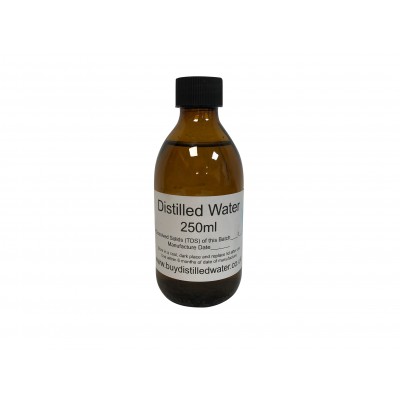
Our 250ml amber glass bottle of Distilled Water is ideal for making Colloidal Silver and mixtures that need protection from sunlight. Choosing our Distilled Water in amber glass bottles offers numerous benefits, making it an excellent choice for those seeking longer term storage options. Amber glass effectively blocks harmful UV rays, preserving the water's purity for longer.
The glass bottle is also fully reusable for home made cosmetics and tinctures.
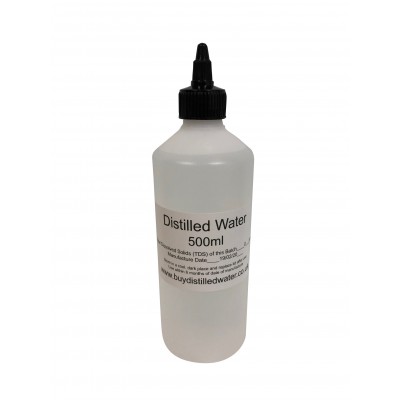
Our 500ml bottle of Distilled Water complete with easy dispense twist nozzle - Perfect for use at home in steam irons, humidifiers, steam generators etc.
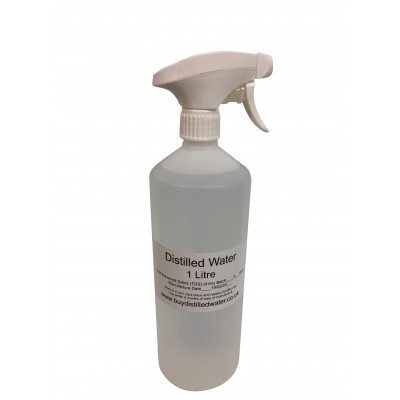
Our handy 1 Litre bottle complete with 'spray' and 'jet' trigger spray. Perfect for regular home users as well as testing purposes.
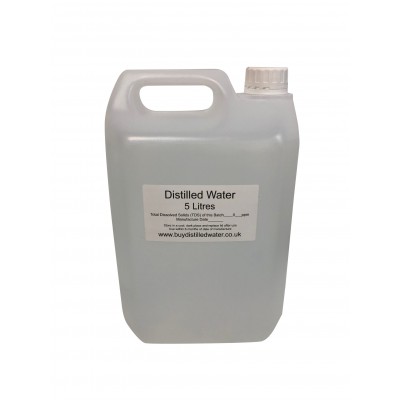
Pure, Distilled Water - Now Available in 5 Litre Containers
From £6.45 ex. VAT.
IN STOCK NOW! Our 5 litre Distilled Water drum is economical, yet easy to carry and pour. Our 5 litre bottles have an integral handle and are designed to be easy to transport and store. The larger size makes them perfect for larger applications, while still being light enough to carry.
Our 5 litre drum is the convenient, great‑value size for regular users who still want easy handling and storage. Every batch is steam‑distilled, polished through mixed‑bed resins and UV‑treated, then bottled in brand‑new, food‑grade HDPE with a tamper‑evident screw cap. We’ve specialised in distillation since 2008, with daily EC/TDS checks and periodic UKAS‑accredited lab analysis.
Each of our 5 litre distilled water bottles is equipped with a tamper-evident screw cap, making it easy to tell if the bottle has been opened. These food-grade HDPE containers are certified BPA-free.
Distilled water is the purest form of water available. Unlike filtered water, distilled water goes through a 6-stage process that removes impurities, sediment and minerals. As a result, it's far purer than any other type of water.
Uses & applications
Ideal wherever low‑conductivity, mineral‑free water prevents deposits or interference:
- CPAP machines and home humidifiers
- Steam irons and garment steamers
- Lead‑acid car batteries and coolant top‑ups
- Autoclaves, sterilisers and lab glassware rinsing
- Cosmetics blending and printing/photography
- Optics and electronics cleaning/setup
- Houseplants (e.g., orchids, carnivorous plants)
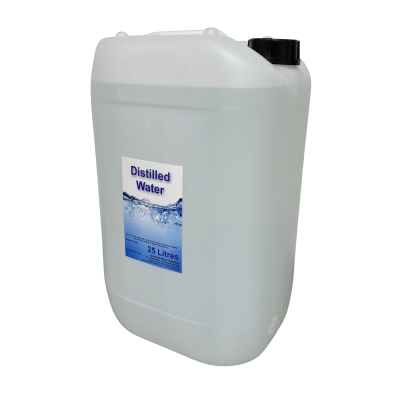
From £20.95 ex. VAT.
IN STOCK NOW! Our 25 litre Distilled Water drum is the most economical way to buy ultra pure distilled water from us. Perfect for jobs requiring large volumes such as research laboratories and industrial processes. The drum is made from food-grade HDPE and comes complete with a tamper-evident screw cap. For additional savings on larger orders, we can send the drums on a pallet to reduce packaging and delivery charges - Palletised delivery is available on quantities from 9 drums (see below).
Buy 25 litre drums of distilled water directly from the manufacturer. We use our own proprietary 6-step method to ensure our water is of the highest quality and it undergoes UV sterilisation prior to bottling to further reduce potential bacteria. Our water is 100% steam distilled, not just filtered, deionised, or reverse osmosis water. After you buy distilled water from us, keep the drum sealed and away from sunlight, storing it between 15-25°c.
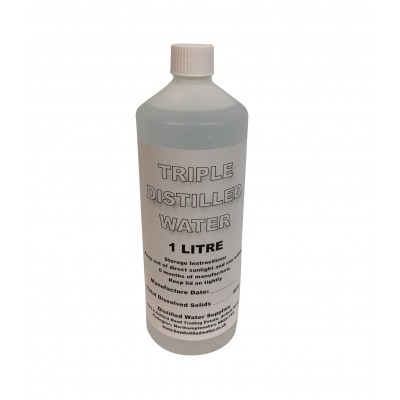
The latest addition to our range of waters. This triple distilled water is batch made in laboratory glassware for applications requiring the highest purity levels. Water is distilled on day of dispatch for maximum freshness.
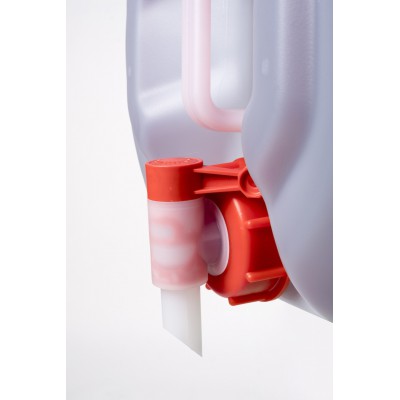
A robust and hard wearing dispensing tap that can be screwed directly on to our 25 litre drums for precise and accurate pouring.
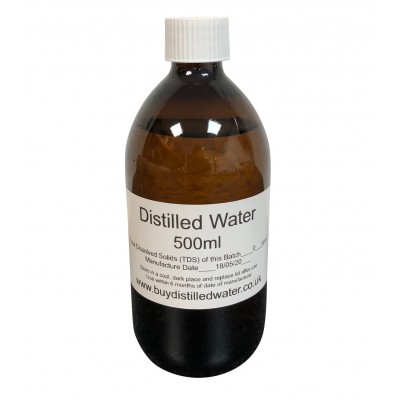
This 500ml amber glass bottle of Distilled Water is ideal for making Colloidal Silver and mixtures that need protection from sunlight
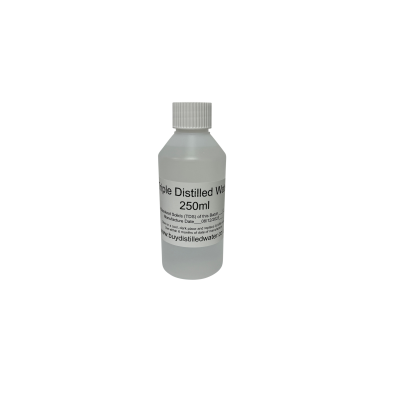
IN STOCK NOW! 250ml bottles of our triple distilled water - Perfect for use at home for applications requiring ultra pure distilled water that has undergone distillation three times.
Triple Distilled Water improves on the purity of our regular distilled water. By undergoing the distillation process three times, each cycle further refines and purifies the water, ensuring that any remaining impurities are meticulously removed. Our triple process guarantees a level of purity that is unparalleled, making it an ideal choice for a variety of uses such as making colloidal silver and homemade cosmetics and soaps, ensuring that the final products are free from any impurities that could irritate the skin.
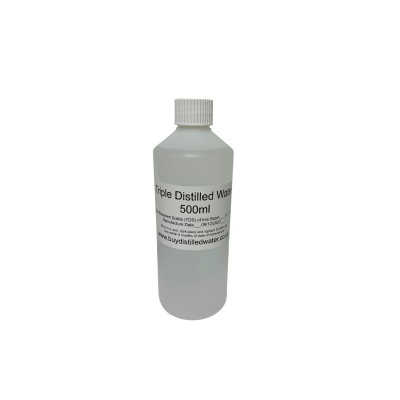
IN STOCK NOW! 500ml bottles of our triple distilled water - Perfect for use at home for applications requiring ultra pure distilled water that has undergone distillation three times.
Triple Distilled Water improves on the purity of our regular distilled water. By undergoing the distillation process three times, each cycle further refines and purifies the water, ensuring that any remaining impurities are meticulously removed. Our triple process guarantees a level of purity that is unparalleled, making it an ideal choice for a variety of uses such as making colloidal silver and homemade cosmetics and soaps, ensuring that the final products are free from any impurities that could irritate the skin.
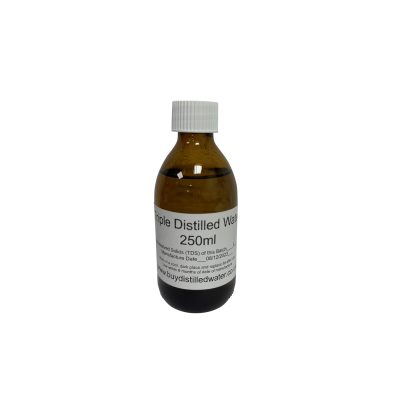
IN STOCK NOW! 250ml bottles of our triple distilled water - Perfect for use at home for applications requiring ultra pure distilled water that has undergone distillation three times.
Triple Distilled Water improves on the purity of our regular distilled water. By undergoing the distillation process three times, each cycle further refines and purifies the water, ensuring that any remaining impurities are meticulously removed. Our triple process guarantees a level of purity that is unparalleled, making it an ideal choice for a variety of uses such as making colloidal silver and homemade cosmetics and soaps, ensuring that the final products are free from any impurities that could irritate the skin.
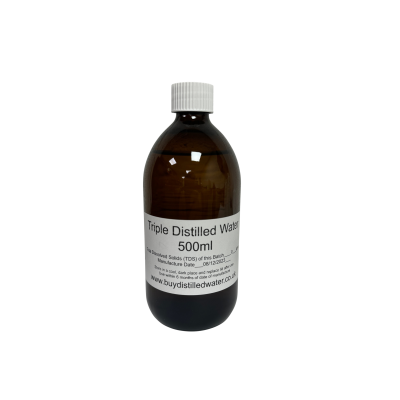
IN STOCK NOW! 500ml bottles of our triple distilled water - Perfect for use at home for applications requiring ultra pure distilled water that has undergone distillation three times.
Triple Distilled Water improves on the purity of our regular distilled water. By undergoing the distillation process three times, each cycle further refines and purifies the water, ensuring that any remaining impurities are meticulously removed. Our triple process guarantees a level of purity that is unparalleled, making it an ideal choice for a variety of uses such as making colloidal silver and homemade cosmetics and soaps, ensuring that the final products are free from any impurities that could irritate the skin.